On this page
Call a lead back as fast as you possibly can, ideally within a minute or two of a missed call; wait even an hour and your odds of qualifying that lead drop sharply, according to a widely cited Harvard Business Review study on sales leads (Oldroyd, McElheran & Elkington, "The Short Life of Online Sales Leads," Harvard Business Review, 2011, retrieved 2026-09-26). Speed to lead is not a nice-to-have; it is close to the whole game.
This guide is for small business owners and office managers who want a straight answer on how fast a callback needs to be, what the research actually shows, and how to build a callback process that doesn't depend on someone being free at the exact right second. It covers the data, a practical checklist, and where an always-on AI receptionist removes the need to race the clock at all.
Key Takeaways
- A widely cited study of 2,241 U.S. companies found firms that tried to contact a web lead within an hour were nearly 7 times more likely to qualify it than those that waited even one more hour, and more than 60 times more likely than firms that waited 24 hours or longer (Oldroyd, McElheran & Elkington, Harvard Business Review, 2011, retrieved 2026-09-26).
- 78% of buyers go with the first business that responds to them, based on Voksha's analysis of industry benchmark data (Voksha Industry Benchmarks, retrieved 2026-09-26).
- Most businesses aren't close to fast: only 37.8% of inbound calls get answered live, and 32% of all calls arrive outside 9-5 weekday hours (Voksha After-Hours Economy Report, retrieved 2026-09-26).
- Customer service interactions that take longer, or make a caller repeat information, measurably hurt satisfaction, which is the same dynamic that kills a slow lead callback (J.D. Power 2023 U.S. Cross-Industry Customer Service Experience Study, retrieved 2026-09-26).
- An AI receptionist that answers every call live removes speed-to-lead risk entirely, because there is no missed call to race back to.
Why Speed To Lead Decides Whether You Get The Job
Speed to lead is how fast a business responds to a new inquiry, and it is one of the few variables in sales that a business fully controls. A prospect who calls you has usually called, or is about to call, someone else too. The business that reaches them first, while they're still holding the phone or still thinking about the problem, wins a disproportionate share of that work.
Voksha's own research found that 78% of buyers choose the first business that responds to them, drawing on the same industry data that shows law firms alone miss roughly 35% of their inbound calls (Voksha Industry Benchmarks, retrieved 2026-09-26, citing Clio's Legal Trends Report). That pattern is not unique to law firms. Home service companies, salons, medical practices and any business that competes on availability sees the same effect: the first callback usually gets the job, not the best callback.
The 90-Second Callback Window
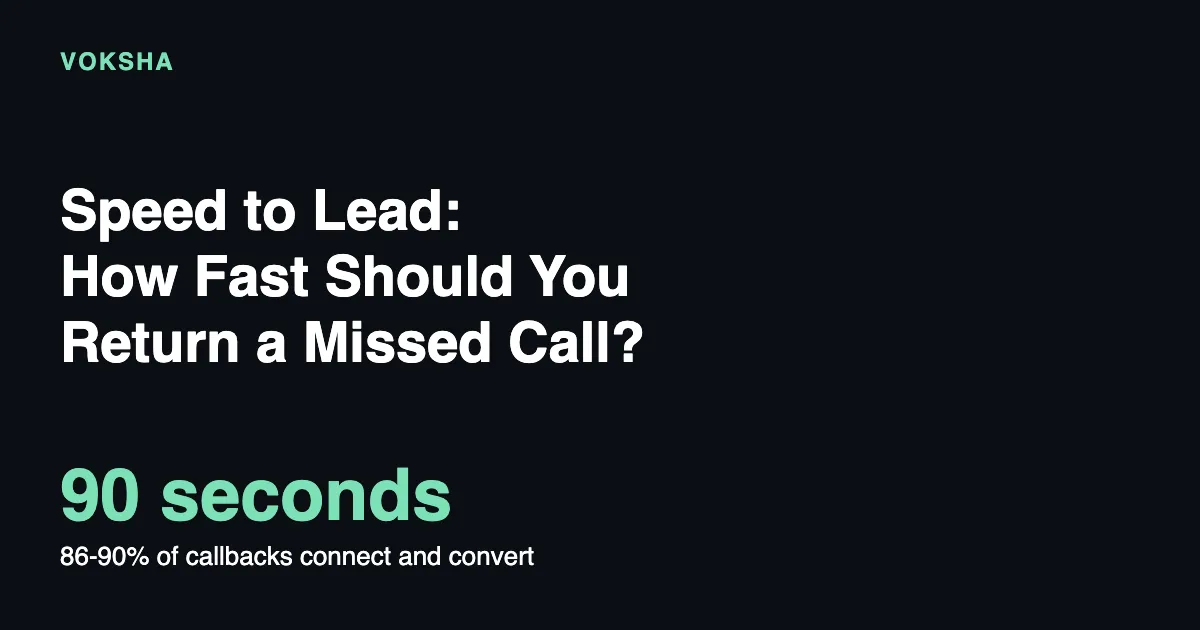
The window that matters most is short. A good rule of thumb is to try to return a missed call within about 90 seconds.
Ninety seconds is short enough that the caller hasn't put the phone down, opened a browser tab, or dialed the next name on their list. It is long enough to be realistic for a real callback process, as long as someone is watching for missed calls in real time.
The practical problem is that "watch for missed calls in real time, every hour of every day" is not a job most small businesses can staff. That's the gap between what the data says works and what most businesses can actually deliver with a person alone.
What The Research Says About Lead Response Time
The best-known academic look at this question is a 2011 Harvard Business Review study by James Oldroyd, Kristina McElheran and David Elkington, which audited how 2,241 U.S. companies handled test web leads. The study found that firms which attempted to contact a lead within an hour of it arriving were nearly 7 times more likely to qualify that lead than firms that waited even one more hour, and more than 60 times more likely than firms that waited 24 hours or longer (Oldroyd, McElheran & Elkington, "The Short Life of Online Sales Leads," Harvard Business Review, 2011, retrieved 2026-09-26).
That study measured web-form leads, not phone calls, but the underlying mechanism is the same one Voksha's phone data shows: interest decays fast, and a business that responds while the interest is still fresh gets a very different outcome than one that responds after it has cooled. A missed phone call is, if anything, a hotter lead than a web form fill: the person picked up a phone and dialed a number, which is a higher-intent action than typing an email address into a box.
The mechanism behind both findings shows up in customer service research more broadly. J.D. Power's 2023 cross-industry study found that slow, effortful service interactions, including having to repeat information, measurably drag down satisfaction (J.D. Power 2023 U.S. Cross-Industry Customer Service Experience Study, retrieved 2026-09-26). Speed isn't just about beating a competitor to the punch; it's about the caller's own patience for waiting.
Why Most Businesses Respond Too Slowly
Most businesses aren't close to a 90-second standard, and it isn't for lack of trying. Two structural problems get in the way.
The first is coverage. Businesses answer only 37.8% of the calls that come in, meaning most calls are missed calls from the start, before any callback clock even starts (Voksha After-Hours Economy Report, retrieved 2026-09-26). The second is timing. Calls don't arrive on a 9-to-5 schedule: 32% land outside weekday business hours, and 23% land on weekends (Voksha After-Hours Economy Report, retrieved 2026-09-26). A staff member who is off the clock, in a client meeting, or on another line cannot hit a 90-second window, no matter how motivated they are.
The table below shows why the gap between "should call back fast" and "does call back fast" is so wide for a business relying on people alone.
| Callback method | Realistic response time | What limits it |
|---|---|---|
| Staff callback during business hours | Minutes to hours | Depends on someone being free and noticing the missed call |
| Staff callback after hours or weekends | Hours to next business day | No one is on the clock to notice the call at all |
| Voicemail with a promise to call back | Often never | 80-85% of callers routed to voicemail hang up without leaving a message (Voksha After-Hours Economy Report, retrieved 2026-09-26) |
| AI receptionist answering live | Immediate, no callback needed | Nothing; the call is answered on the first ring |
Building A Speed-To-Lead Process That Works
A speed-to-lead process is only as good as its weakest hour. Use this checklist to find where yours breaks down:
- Log every missed call with a timestamp. You cannot fix a callback window you aren't measuring.
- Set a written callback standard, for example "call back within 90 seconds during business hours, within 5 minutes after hours," and make it visible to whoever owns the phone.
- Assign ownership for every hour the phone might ring, including evenings, weekends, and lunch breaks, not just the 9-to-5 shift.
- Route the call to the next available person automatically rather than relying on one line or one phone.
- Track connect and conversion rates by response time band (under 90 seconds, 90 seconds to 5 minutes, over 5 minutes) so you can see the drop-off for yourself.
- Close the coverage gaps you can't staff with an always-on answer, rather than accepting missed calls as a cost of doing business.
Most businesses can tighten steps 1 through 5 with better process alone. Step 6 is where an automated answer, not a faster human, closes the remaining gap.
Where An AI Receptionist Fits
The cleanest way to guarantee a 90-second response, every hour of every day, is to make sure no call is ever missed in the first place. An AI receptionist like Voksha answers every inbound call live, 24/7, including nights, weekends and moments when staff are already on another line. There is no callback race, because the call was already answered on the first ring, the caller's details were captured and, on the Premium plan, the appointment was booked directly into the calendar.
This matters most for the calls that arrive at the worst times for a human team: the 32% that land outside weekday hours and the 23% that land on weekends, exactly the hours when a "call back fast" policy is hardest to keep (Voksha After-Hours Economy Report, retrieved 2026-09-26). Voksha works in English on Starter, two languages on Premium, and more on Enterprise, so on the right plan speed to lead doesn't depend on whether the caller speaks fluent English. Every plan is SOC 2 compliant and ISO 27001 compliant, and HIPAA compliance with BAAs is available on the Enterprise plan for regulated practices.
Voksha routes to a human whenever a call needs judgment a script can't provide: a distressed caller, a complex negotiation, or a request outside what the AI is confident handling. For calls that fit a standard pattern, like capturing contact details on any plan or booking a consultation on Premium, the AI resolves the interaction itself instead of creating a callback task for later. For more on why answering every call beats chasing the ones you miss, see Voksha's page on how to stop missing calls and the related post on what a missed call really costs. For how the AI decides which leads to route where, see Voksha's lead qualification page.
How This Guide Was Sourced
This guide draws on Voksha's After-Hours Economy Report and Industry Benchmarks report for call-answer rates, after-hours call share, and the 78% first-responder statistic. Non-Voksha sources are the 2011 Harvard Business Review study by Oldroyd, McElheran and Elkington on web lead response time, and J.D. Power's 2023 U.S. Cross-Industry Customer Service Experience Study on the link between response effort and satisfaction. All external sources were retrieved on 2026-09-26. Written by the Voksha team. Voksha builds AI receptionists for small businesses.
Frequently Asked Questions
How fast should I call back a missed lead?
Aim for within 90 seconds if at all possible, while the caller is still holding the phone. If 90 seconds isn't realistic for your team, treat 5 minutes as a hard outer limit, since research on web leads shows qualification rates fall sharply after the first hour.
Does speed to lead matter more than the quality of the callback?
Both matter, but speed comes first because a slow callback often never happens: the prospect has already booked with the business that answered first. A fast, average callback usually beats a perfect callback placed an hour later.
What if my business can't staff instant callbacks 24/7?
Most small businesses can't, which is normal. The realistic fix is closing the biggest gaps first, evenings, weekends and lunch hours, either with rotating staff coverage or an AI receptionist that answers every call live so there is no callback needed at all.
Is the 78% first-responder statistic specific to any one industry?
Voksha's Industry Benchmarks report draws this figure from data that includes law firms, but the underlying dynamic, that buyers pick whoever responds first, shows up across home services, medical and dental practices, salons and other appointment-driven businesses.
Conclusion
Speed to lead comes down to one honest question: can your business answer or call back within 90 seconds, every hour it might ring? For most small businesses relying on people alone, the answer is no, not because of effort, but because of coverage. Closing that gap with process is a start; closing it completely means making sure no call goes unanswered in the first place. See Voksha's pricing to find out what a 24/7 AI receptionist costs for a business your size.